Before you drive a rental car in Australia: licence rules and driving on the left
Australia drives on the left, and you can drive on a foreign licence in English for up to three months. Licences not in English need an International Driving Permit or a translation, and conditions differ slightly by state.
Driving coastal roads or across the inland is one of the joys of travelling in Australia. But if you come from a country that drives on the right, you may wonder whether your licence is valid and how quickly you will adjust to the other side of the road. Here is what to check before you set off, based on Tourism Australia's driving guide and official state pages.
Driving on a foreign licence
According to Tourism Australia, you can use a foreign licence for up to three months if it is in English. If it is not, you need an International Driving Permit (IDP), which you get from your local automobile association before leaving home. If your licence has no photo, carry your passport when you drive.
States have their own rules too. The New South Wales (NSW) Government says tourists and temporary overseas visitors can drive on a current overseas licence for up to six months. Carry your licence, and if it is not in English, also carry an English translation or an IDP. You can drive vehicles in the car class (class C): 4.5 tonnes gross vehicle mass or less, seating up to 12 people including the driver. The NSW page also offers fact sheets (PDF) in languages including Japanese, Korean, Chinese and Spanish.
The Queensland Government says visitors can drive with a valid overseas licence. Drive only the vehicle class on your licence, follow its conditions and show it to police when asked. If your licence is not in English, it advises carrying a recognised English translation.
Getting used to the left
The first thing to remember is to drive on the left. Remembering that the driver should always be near the centre of the road helps you stay in the right lane. Overtake on the right, go clockwise at roundabouts, and give way to the right at roundabouts and intersections.
Tourism Australia recommends hiring an automatic if you are not used to driving on the left. In a manual car you change gears with your left hand, and the indicators and wipers may be on the opposite side.
Speed, seatbelts, phones and alcohol
Speeds are in kilometres: 50 km/h in urban areas unless signposted otherwise, 100 km/h on most other roads and up to 110 km/h on some highway stretches. Enforcement is strict, and hidden speed cameras are widely used. Seatbelts are compulsory for everyone, and there are rules for children's car seats.
Using a mobile phone while driving is illegal, even when stopped at lights or in traffic. If you use a map app, have a hands-free cradle. The blood alcohol limit is 0.05, and police carry out roadside breath and drug tests.
Toll roads and fines
Many motorways in the capital cities are toll roads paid with an electronic tag or pass. You can hire one with your car or buy a visitor pass from the state roads authority's website. In most cases you can also pay online up to 3 days after using the road. Speeding fines go to the hire company and may be taken from your credit card or security bond if unpaid.
Country roads and night driving
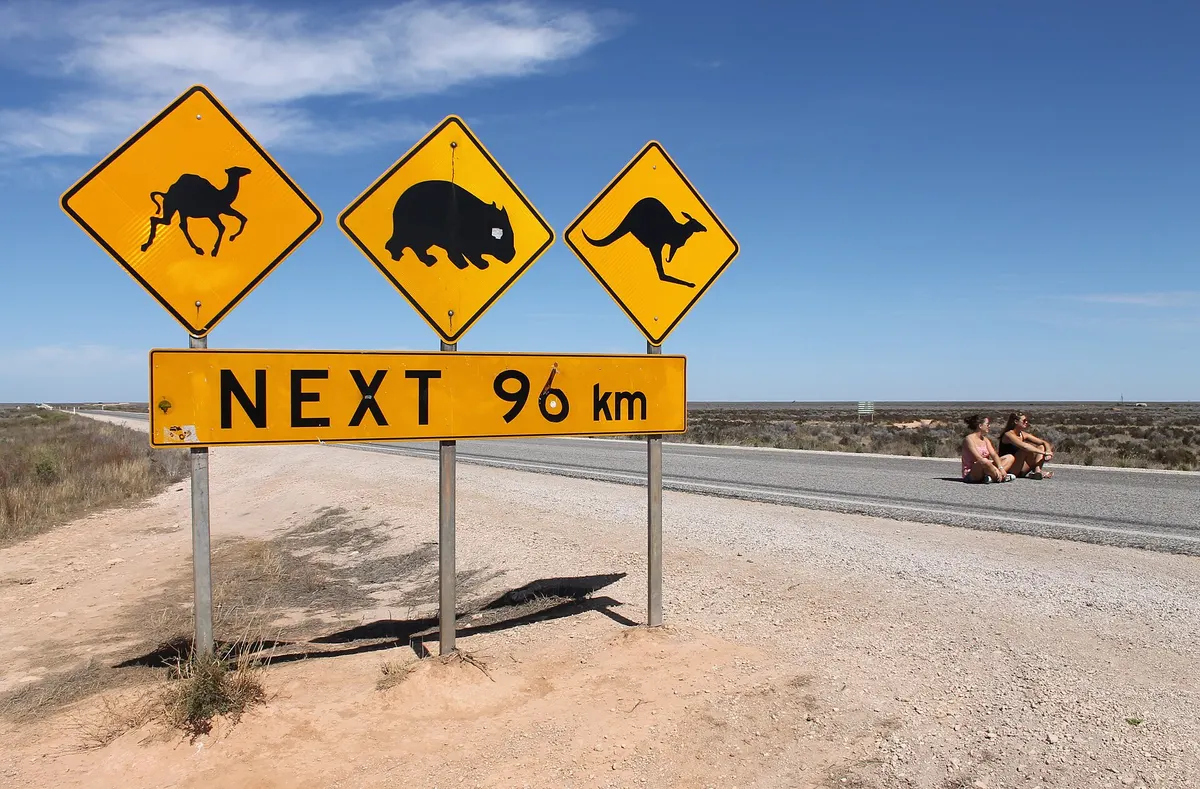
In the outback and country areas, it is best not to drive at night, because animals such as kangaroos are very hard to see in the dark. Outside cities, mobile coverage can be patchy, so carry a map rather than relying only on your phone.
In cities and large towns, fuel is generally available 24 hours, but in the country stations may close at night and on weekends. Some four-wheel drives and campervans run on diesel, so check before filling up. If you are heading somewhere remote, carrying a spare container of fuel is wise.
Rules differ by state and can change. Before you drive, check the latest information in Tourism Australia's guide and on the official pages of the state you are driving in, such as NSW and Queensland.
PRAiraloSee Australia eSIMs on Airalo↗