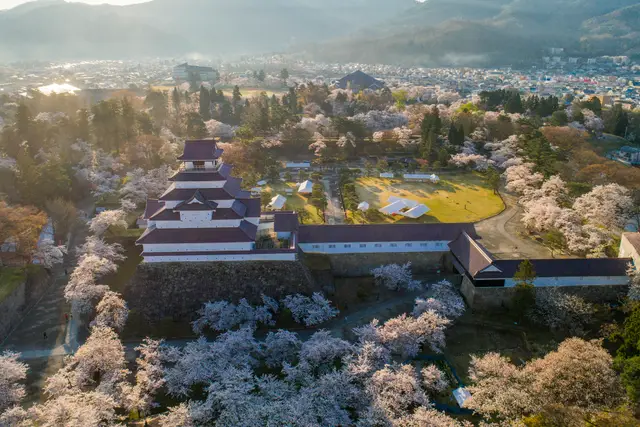
Aizu-Wakamatsu guide
The castle town of the Aizu domain, scene of the Boshin War. A loop bus links Tsurugajo Castle, Mt. Iimori of the Byakkotai and old Nanokamachi; the thatched post town of Ouchi-juku and Kitakata's ramen are nearby.
Things to see 11 classics
"Classics", "For visitors" and "Local picks" are this site's editorial picks, not a measured popularity ranking.
- 1
Tsurugajo Castle (Wakamatsu Castle)
A keep with red roof tiles that held out for a month in the Boshin War. Inside is a museum; the top floor looks out to Mt. Bandai.
- History & buildings
- Views
Paid entryPartly step-free
Bus · About 30 min from Aizu-Wakamatsu ・ Haikara-san loop bus to Tsurugajo Iriguchi, then about 5 minutes on foot ・ 2.3km
- 2
Mt. Iimori (Sazaedo Hall and Byakkotai graves)
The hill where the boy soldiers of the Byakkotai rest, with Sazaedo, a wooden hall whose spiral ramps never cross.
- History & buildings
- Views
Bus · About 20 min from Aizu-Wakamatsu ・ Akabe loop bus to Iimoriyama-shita, then about 5 minutes on foot ・ 2.1km
- 3
Oyakuen Garden
A lord's stroll garden around a pond shaped like the character for heart, with a medicinal herb garden. Matcha is served in the teahouse.
- Nature
- History & buildings
Paid entryPartly step-free
Bus · About 30 min from Aizu-Wakamatsu ・ Haikara-san loop bus to Oyakuen ・ 2.3km
- 4
Nanokamachi-dori Street
A street of Taisho-era buildings, lined with old shops and stores in former storehouses. Good for a stroll.
- Shopping & strolling
- Food & markets
- History & buildings
Bus · About 15 min from Aizu-Wakamatsu ・ Haikara-san loop bus to Nanokamachi Chuo ・ 1.2km
- 5
Aizu Bukeyashiki (Samurai Residences)
A reconstruction of the mansion of Saigo Tanomo, a chief retainer of Aizu. You can also paint your own akabeko cow.
- History & buildings
- With kids
Paid entryPartly step-free
Bus · About 15 min from Aizu-Wakamatsu ・ Akabe loop bus to Aizu Bukeyashiki-mae ・ 3.2km
- 6
Suehiro Sake Brewery Kaeigura
A sake brewery dating from the 1850s. A guided tour ends with a tasting, and there is a café in the oldest storehouse.
- Food & markets
- History & buildings
about 45 minFreeFine on a rainy day
Bus · About 20 min from Aizu-Wakamatsu ・ Haikara-san loop bus to Nanokamachi Chuo, then about 5 minutes on foot ・ 1.3km
Show on map
ClassicsFor visitorsLocal picks
Suggested routes
Times assume a 9:00 start. Travel times are estimated from distance and vary with waiting and crowds.
Aizu's castle town by loop bus
Leave 9:00 → until about 14:23 (about 5.5 hr)
- 9:00Aizu-Wakamatsu
about 20 min by transport
9:20Mt. Iimori (Sazaedo Hall and Byakkotai graves)stay about 45 minabout 15 min by transport
10:20Aizu Bukeyashiki (Samurai Residences)stay about 45 minabout 18 min on foot
11:23Oyakuen Gardenstay about 45 minabout 22 min on foot
12:30Tsurugajo Castle (Wakamatsu Castle)stay about 45 minabout 23 min on foot
13:38Nanokamachi-dori Streetstay about 45 min
This is the order the Akabe bus runs. A one-day pass is handy.
Plan this routeGorge and post town by the Aizu Railway
Leave 9:00 → until about 13:35 (about 4.5 hr)
- 9:00Aizu-Wakamatsu
about 60 min by transport
10:00To-no-Hetsuristay about 45 minabout 15 min by transport
11:00Ouchi-jukustay about 45 minabout 65 min by transport
12:50Higashiyama Onsenstay about 45 min
To-no-Hetsuri and Yunokami-Onsen are neighboring stations. From Yunokami-Onsen, take the bus or a taxi up to Ouchi-juku.
Plan this routeThe domain school, Inawashiro and Urabandai
Leave 9:00 → until about 14:30 (about 5.5 hr)
- 9:00Aizu-Wakamatsu
about 35 min by transport
9:35Aizu Domain School Nisshinkanstay about 45 minabout 45 min by transport
11:05Noguchi Hideyo Memorial Museumstay about 45 minabout 40 min by transport
12:30Goshikinuma Ponds (Urabandai)stay about 2 hr
Beyond Inawashiro Station you travel by bus. Buses are infrequent, so check the return times first.
Plan this route
Main ways to get around
Machinaka loop buses (Haikara-san and Akabe)
From Aizu-Wakamatsu Station they loop past Nanokamachi, Tsurugajo Castle, Oyakuen, Higashiyama Onsen and Mt. Iimori; Akabe runs the opposite way. A one-day pass is sold.
JR Ban-etsu West Line
Runs from Koriyama, on the Tohoku Shinkansen, to Aizu-Wakamatsu. Inawashiro Station on the way is the gateway to the Noguchi Hideyo museum and Urabandai. It continues to Kitakata.
Aizu Railway
From Aizu-Wakamatsu to To-no-Hetsuri and Yunokami-Onsen (for Ouchi-juku). Beyond Nishi-Wakamatsu it is the Aizu Railway: pay that part in cash, as IC cards are not accepted.
JR Tadami Line
Runs from Aizu-Wakamatsu through the mountains along the Tadami River; about 1.5 hours to Aizu-Miyashita. Trains are very few, so check the return times before you go.
Highway bus (Shinjuku – Aizu-Wakamatsu)
About 4 hours 50 minutes between the Wakamatsu Ekimae bus terminal and Shinjuku, 8 round trips a day. You can board without a reservation.
Getting to Aizu-Wakamatsu
“Classics”, “For visitors” and “Local picks” are our editors' picks, not a measured popularity ranking. Travel times are estimates. Please check prices, opening hours and operating days with the official sources before you go.
Local food specialties
Specialties of Aizu-Wakamatsu, together with those of other places in Fukushima. They are listed by dish, not by shop, and are not recommendations.
Rice dishes
Aizu sauce katsudon (pork cutlet in sauce over shredded cabbage and rice)
会津ソースカツ丼
Rice topped with shredded cabbage and a pork cutlet dipped in sauce. Portions are large, and cutlet thickness and flavor vary by shop.
- Known in
- Aizuwakamatsu
Rice dishes
Aizu wappa-meshi (steamed rice with seasonal toppings in a bent cypress box)
会津のわっぱ飯
Aizu rice and seasonal ingredients steamed in a bent cypress container, with a faint wood aroma.
- Known in
- Aizuwakamatsu
Meat
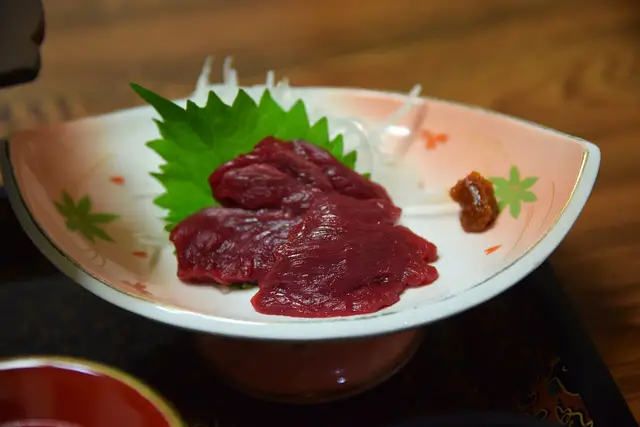
Aizu basashi (horse meat sashimi with karashi miso)
会津の馬刺し
Lean, red-meat horse sashimi, eaten with karashi miso (mustard-chili miso) dissolved in soy sauce.
- Known in
- Aizuwakamatsu
Noodles
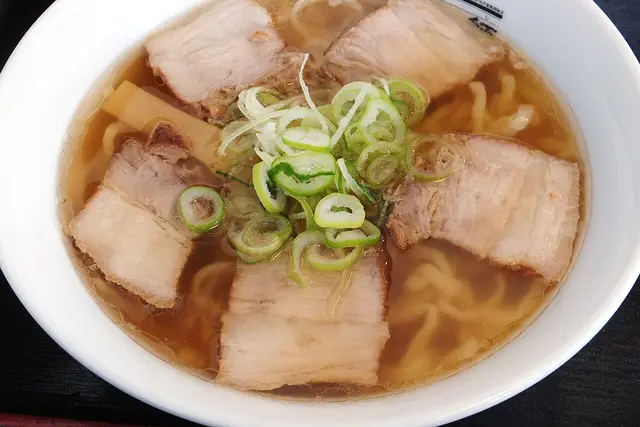
Kitakata ramen (soy ramen with thick curly noodles)
喜多方ラーメン
Ramen with a rich soy-and-sake soup and thick curly noodles. About 100 shops in the city; locals have a custom of eating it for breakfast.
- Known in
- Kitakata
Noodles
Shirakawa ramen (whole-chicken broth with flat curly noodles)
白河ラーメン
Ramen with broth from whole chicken, chicken bones and pork bones, and flat curly noodles. Many shops in and around Shirakawa.
- Known in
- Shirakawa · Shirakawa and Tanagura guide
Meat
Fukushima enban gyoza (disc-shaped ring of fried gyoza)
福島の円盤餃子
Fukushima City gyoza fanned out on a round plate, vegetable-heavy. Almost all member restaurants open in the evening.
- Known in
- Fukushima City · Fukushima City, Iizaka and Nihonmatsu guide
Noodles
Namie yakisoba (extra-thick noodles with pork and bean sprouts)
なみえ焼そば
Extra-thick noodles in a special sauce with only pork and bean sprouts. Eaten in Namie for about half a century.
- Known in
- Namie · Soma, Minamisoma and Futaba guide
Seafood
Mehikari karaage (deep-fried greeneye fish, Iwaki's city fish)
メヒカリの唐揚げ
Deep-fried greeneye fish landed at Iwaki. One of Iwaki's fish dishes certified by the Agency for Cultural Affairs as a 100-year food.
- Known in
- Iwaki · Iwaki guide
Hot pots & soups
Ankou no dobujiru (monkfish stew)
あんこうのどぶ汁
A stew made with monkfish. Certified as a 100-year food by the Agency for Cultural Affairs as one of Iwaki's fish dishes.
- Known in
- Iwaki · Iwaki guide
Street food
Koriyama Cream Box (thick-cut bread with milky cream)
こおりやまクリームボックス
Thick-sliced bread spread with milk-flavored cream. Originated in Koriyama and sold at about 20 shops in the city.
- Known in
- Koriyama · Koriyama, Sukagawa and Miharu guide
“Find places serving it” opens a map app search for the dish name and the place name. The results are not chosen or recommended by this site. Please check with the shop whether it serves the dish.
Traditional home dishes of Fukushima (30)When to go
May and October are pleasant at 14–16°C on average. Tsurugajo's cherry blossoms peak in early to mid April. Winters average about 0°C with heavy snow, up to 50 cm deep in Jan–Feb.
Point at a month to see its temperature and precipitation.
Temperature (line: average; band: low to high)
Precipitation (mm)
Typical seasons
Cherry blossoms (Tsurugajo Castle)
Candle festival and Ouchi-juku snow fest
Aizu Festival
Autumn leaves (Tsurugajo, Oyakuen)
Snowy scenes (Tsurugajo, Ouchi-juku)
Show as a table
| Jan | Feb | Mar | Apr | May | Jun | Jul | Aug | Sep | Oct | Nov | Dec | |
|---|---|---|---|---|---|---|---|---|---|---|---|---|
| High (℃) | 2.9 | 4 | 8.9 | 16.6 | 22.7 | 26 | 29.2 | 30.8 | 26.1 | 19.5 | 12.2 | 5.7 |
| Avg (℃) | -0.3 | 0.1 | 3.7 | 10.1 | 16.2 | 20.5 | 24 | 25.2 | 20.8 | 14.1 | 7.4 | 2.2 |
| Low (℃) | -3.4 | -3.5 | -0.7 | 4.3 | 10.3 | 15.9 | 20.1 | 20.8 | 16.6 | 9.8 | 3.3 | -0.9 |
| Rain (mm) | 102.4 | 69.2 | 77.5 | 63.1 | 75.8 | 108.6 | 196.4 | 139.1 | 124 | 112.6 | 75.5 | 108.7 |
Temperature and precipitation are Japan Meteorological Agency normals (1991–2020, Wakamatsu). Seasons are typical timings and can shift by a week or two each year. JMA data
Practical booking & planning links (Ad)
- Activities, tickets & local tours
- Popular observatories, museums and theme parks increasingly require timed-entry tickets booked in advance. For countryside spots with infrequent buses, a local day tour can save hours.
- KlookKKday
- Rental cars
- A rental car is practical when travelling straight from an airport or exploring rural areas with few trains. Request child seats, an ETC toll card, or winter snow tyres when booking.
- Klook
- Restaurant reservations & food tours
- Well-known dinner spots and course restaurants often fill up days ahead—reserving a table saves waiting in line. Guided local food tours are also a great way to try regional dishes.
- Klook
We list only well-established booking services. This site may receive a commission if you book through these links (each opens in a new tab).
Comment on whether your booking was helpful
Sources
Local food specialties
Each specialty was checked against an official page (prefecture, municipality, tourism association or JNTO) on 2026-11-17. The descriptions were written by this site.
- Aizu sauce katsudon (pork cutlet in sauce over shredded cabbage and rice): www.aizukanko.com
- Aizu wappa-meshi (steamed rice with seasonal toppings in a bent cypress box): www.aizukanko.com
- Aizu basashi (horse meat sashimi with karashi miso): www.aizukanko.com
- Kitakata ramen (soy ramen with thick curly noodles): www.tif.ne.jp
- Shirakawa ramen (whole-chicken broth with flat curly noodles): www.tif.ne.jp
- Fukushima enban gyoza (disc-shaped ring of fried gyoza): www.tif.ne.jp
- Namie yakisoba (extra-thick noodles with pork and bean sprouts): www.tif.ne.jp
- Mehikari karaage (deep-fried greeneye fish, Iwaki's city fish): www.city.iwaki.lg.jp
- Ankou no dobujiru (monkfish stew): www.city.iwaki.lg.jp
- Koriyama Cream Box (thick-cut bread with milky cream): www.tif.ne.jp
Photo and data credits
Tsuruga Castle surrounded by cherry blossoms, above Aizu-Wakamatsu SQZ (CC BY 4.0) / Basashi, raw horse meat sashimi, served with a shiso leaf Raita Futo from Tokyo, Japan (CC BY 2.0) / Kitakata ramen in clear soy broth topped with chashu and green onion Lombroso (CC BY-SA 4.0). Cropped and resized.