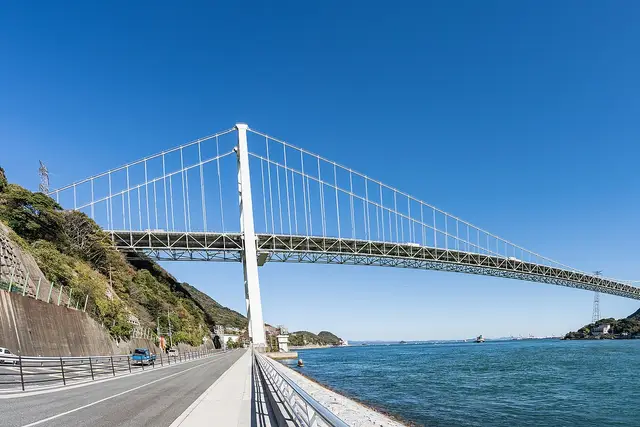
Shimonoseki and the Kanmon Straits guide
A town on the Kanmon Straits between Honshu and Kyushu. Eat fugu at Karato Market, visit Akama Shrine by the old battle site, and cross to Mojiko by boat or undersea tunnel.
Things to see 10 classics
"Classics", "For visitors" and "Local picks" are this site's editorial picks, not a measured popularity ranking.
- 1
Karato Market
A wholesale fish market open to the public. On Fri–Sun and holidays, stalls sell sushi, seafood bowls and fugu soup to eat on the spot.
- Food & markets
- Shopping & strolling
Bus · About 15 min from Shimonoseki ・ About 7 minutes by bus to Karato, then 3 minutes on foot ・ 1.9km
- 2
Akama Jingu Shrine
Enshrines the child emperor Antoku, lost at sea in the battle of Dannoura. Note the palace-like red gate and the hall of Hoichi the Earless.
- Temples, shrines & churches
- History & buildings
Partly paid
Bus · About 15 min from Shimonoseki ・ About 9 minutes by bus to Akama Jingu-mae ・ 2.5km
- 3
Kaikyokan Aquarium
An aquarium known for about 100 kinds of pufferfish, a real blue whale skeleton and one of Japan's largest penguin exhibits.
- With kids
Paid entryFine on a rainy day
Bus · About 15 min from Shimonoseki ・ About 5 minutes by bus to Kaikyokan-mae, then 3 minutes on foot ・ 1.6km
- 4
Kanmon Tunnel pedestrian walkway
A 780 m tunnel under the sea that lets you walk from Honshu to Kyushu in about 15 minutes. Free for pedestrians.
- Activities
- With kids
FreeFine on a rainy day
Bus · About 20 min from Shimonoseki ・ About 12 minutes by bus to Mimosusogawa ・ 3.9km
- 5
Mojiko Retro
The harbor district across the water in Kitakyushu, with red-brick buildings like the old Moji Customs House from its trading-port days.
- History & buildings
- Views
- Shopping & strolling
Ferry · About 30 min from Shimonoseki ・ Bus to Karato, then about 5 minutes on the Kanmon ferry ・ 3.8km
- 6
Ganryujima Island
The small island, about 1.6 km around, where Miyamoto Musashi is said to have dueled Sasaki Kojiro. A path runs along the shore.
- History & buildings
- Nature
Ferry · About 30 min from Shimonoseki ・ Bus to Karato, then about 10 minutes by boat from Karato Pier ・ 1.8km
Show on map
ClassicsFor visitorsLocal picks
Suggested routes
Times assume a 9:00 start. Travel times are estimated from distance and vary with waiting and crowds.
From Karato under the sea to Mojiko
Leave 9:00 → until about 13:50 (about 5 hr)
- 9:00Shimonoseki
about 15 min by transport
9:15Karato Marketstay about 45 minabout 10 min on foot
10:10Akama Jingu Shrinestay about 45 minabout 24 min on foot
11:19Mimosusogawa Parkstay about 45 minabout 1 min on foot
12:05Kanmon Tunnel pedestrian walkwaystay about 45 minabout 15 min by transport
13:05Mojiko Retrostay about 45 min
Lunch at Karato Market, then head east along the water. Walk the tunnel to Moji and take the boat from Mojiko back to Karato.
Plan this routeThe aquarium and Ganryujima
Leave 9:00 → until about 12:54 (about 4 hr)
- 9:00Shimonoseki
about 15 min by transport
9:15Kaikyokan Aquariumstay about 45 minabout 15 min by transport
10:15Ganryujima Islandstay about 45 minabout 20 min by transport
11:20Kameyama Hachimangu Shrinestay about 45 minabout 4 min on foot
12:09Karato Marketstay about 45 min
All around Karato. Boats to Ganryujima are infrequent, so check the times first.
Plan this route
Main ways to get around
Sanden Kotsu local buses
From Shimonoseki Station past Kaikyokan, Karato, Akama Jingu and Mimosusogawa toward Chofu. About 7 minutes to Karato.
Kanmon ferry and Ganryujima boat (Kanmon Kisen)
From Karato Pier it takes about 5 minutes to Mojiko and about 10 to Ganryujima, with views of the Kanmon Bridge along the way.
Kanmon Tunnel pedestrian walkway
Walk 780 m under the sea from Mimosusogawa to Mekari on the Moji side, about 15 minutes. Free for pedestrians.
Sanyo Shinkansen (Shin-Shimonoseki)
Shinkansen trains stop at Shin-Shimonoseki, not Shimonoseki. Change to the JR Sanyo Line for Shimonoseki.
JR Kanmon Tunnel line (Shimonoseki – Moji – Kokura)
Trains run from Shimonoseki through the undersea tunnel to Moji and Kokura. Change at Kokura for Hakata or Kitakyushu Airport.
Getting to Shimonoseki
“Classics”, “For visitors” and “Local picks” are our editors' picks, not a measured popularity ranking. Travel times are estimates. Please check prices, opening hours and operating days with the official sources before you go.
Local food specialties
Specialties of Shimonoseki and the Kanmon Straits, together with those of other places in Yamaguchi. They are listed by dish, not by shop, and are not recommendations.
Seafood
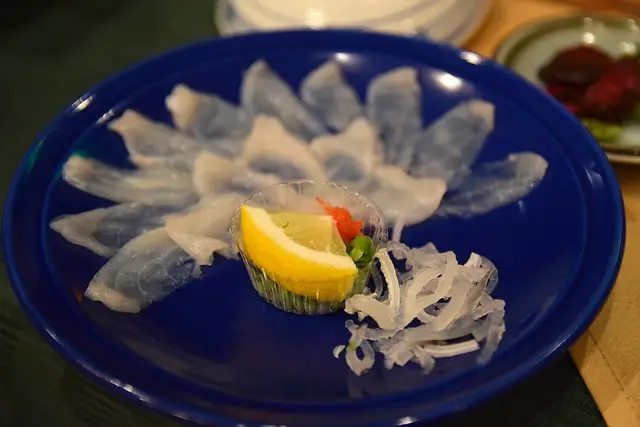
Shimonoseki fugu (blowfish) dishes
下関のふぐ料理
Blowfish dishes such as sashimi and chiri hot pot. Also available casually at Karato Market in Shimonoseki.
- Known in
- Shimonoseki
Hot pots & soups
Tonchan-nabe (offal cooked in its own vegetable juices)
とんちゃん鍋
Beef offal in a sweet-savory sauce cooked only in vegetable juices, no water. Served at yakiniku shops in Shimonoseki.
- Known in
- Shimonoseki
Noodles
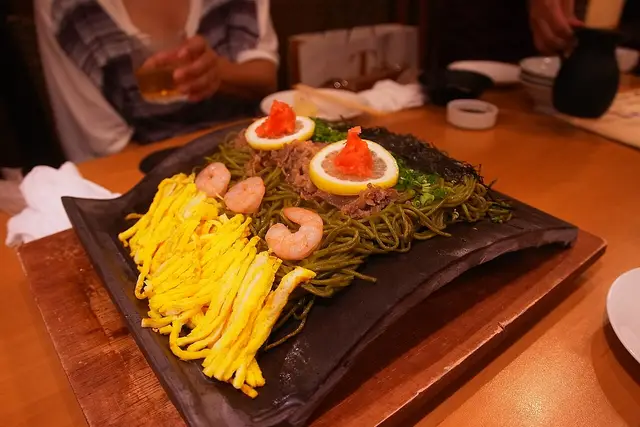
Kawara soba (tea soba served on a hot roof tile)
瓦そば
Tea soba with egg strands and beef on a heated tile, eaten with dipping sauce and lemon. Said to have originated at Kawatana Onsen.
- Known in
- Kawatana Onsen, Shimonoseki
Noodles
Bari soba (crispy noodles with starchy chicken-broth sauce)
ばりそば
Crispy fried noodles topped with a thick, chicken-bone based sauce. Mainly eaten in Yamaguchi City.
- Known in
- Yamaguchi City · Yamaguchi, Yuda Onsen and Hofu guide
Rice dishes
Iwakuni-zushi (layered pressed sushi)
岩国寿司
Pressed sushi with egg strands and Iwakuni lotus root layered over vinegared rice. A specialty of Iwakuni.
- Known in
- Iwakuni City · Iwakuni and Yanai guide
Meat
Nagato yakitori (grilled chicken skewers)
長門やきとり
Yakitori from Nagato, which the prefecture's tourism site introduces as a yakitori town.
- Known in
- Nagato City · Nagato, Senzaki and Motonosumi Shrine guide
Noodles
Gobo-men (burdock noodles)
ごぼう麺
Noodles made with Bito burdock from Mine City. Served at a lunch-only shop near Akiyoshidai and Akiyoshido Cave.
- Known in
- Mine City · Akiyoshidai and Mine guide
Noodles
Ube ramen (rich tonkotsu ramen)
宇部ラーメン
Ramen with medium-thick noodles in rich pork-bone soup. About 15 shops in Ube City.
- Known in
- Ube City
Hot pots & soups
Mikan-nabe (hot pot with mandarin oranges and fish)
みかん鍋
Hot pot with Suo-Oshima mandarins and Seto Inland Sea fish, eaten with mikan pepper. Served October to March.
- Known in
- Suo-Oshima
“Find places serving it” opens a map app search for the dish name and the place name. The results are not chosen or recommended by this site. Please check with the shop whether it serves the dish.
Traditional home dishes of Yamaguchi (30)When to go
Winters are mild, around 7°C on average. June–July is the rainy season (250–310 mm a month). October–November is dry and good for walks along the straits.
Point at a month to see its temperature and precipitation.
Temperature (line: average; band: low to high)
Precipitation (mm)
Typical seasons
Cherry blossoms (Kozanji, Chofu)
Sentei Festival (Akama Jingu)
Autumn leaves (Kozanji)
Show as a table
| Jan | Feb | Mar | Apr | May | Jun | Jul | Aug | Sep | Oct | Nov | Dec | |
|---|---|---|---|---|---|---|---|---|---|---|---|---|
| High (℃) | 9.7 | 10.5 | 13.7 | 18.4 | 22.7 | 25.8 | 29.7 | 31.3 | 27.8 | 23 | 17.5 | 12.3 |
| Avg (℃) | 7.2 | 7.5 | 10.3 | 14.7 | 19.1 | 22.5 | 26.5 | 27.9 | 24.6 | 19.7 | 14.5 | 9.5 |
| Low (℃) | 4.8 | 4.9 | 7.4 | 11.6 | 16.2 | 20.1 | 24.2 | 25.6 | 22.2 | 16.9 | 11.8 | 7 |
| Rain (mm) | 80 | 75.9 | 121.2 | 130.8 | 154.2 | 253.6 | 309.4 | 190 | 162.6 | 83.7 | 81.9 | 69.1 |
Temperature and precipitation are Japan Meteorological Agency normals (1991–2020, Shimonoseki). Seasons are typical timings and can shift by a week or two each year. JMA data
Practical booking & planning links (Ad)
- Activities, tickets & local tours
- Popular observatories, museums and theme parks increasingly require timed-entry tickets booked in advance. For countryside spots with infrequent buses, a local day tour can save hours.
- KlookKKday
- Rental cars
- A rental car is practical when travelling straight from an airport or exploring rural areas with few trains. Request child seats, an ETC toll card, or winter snow tyres when booking.
- Klook
- Restaurant reservations & food tours
- Well-known dinner spots and course restaurants often fill up days ahead—reserving a table saves waiting in line. Guided local food tours are also a great way to try regional dishes.
- Klook
We list only well-established booking services. This site may receive a commission if you book through these links (each opens in a new tab).
Comment on whether your booking was helpful
Sources
Local food specialties
Each specialty was checked against an official page (prefecture, municipality, tourism association or JNTO) on 2026-11-17. The descriptions were written by this site.
- Shimonoseki fugu (blowfish) dishes: yamaguchi-tourism.jp
- Tonchan-nabe (offal cooked in its own vegetable juices): yamaguchi-tourism.jp
- Kawara soba (tea soba served on a hot roof tile): yamaguchi-tourism.jp
- Bari soba (crispy noodles with starchy chicken-broth sauce): yamaguchi-tourism.jp
- Iwakuni-zushi (layered pressed sushi): yamaguchi-tourism.jp
- Nagato yakitori (grilled chicken skewers): yamaguchi-tourism.jp
- Gobo-men (burdock noodles): yamaguchi-tourism.jp
- Ube ramen (rich tonkotsu ramen): yamaguchi-tourism.jp
- Mikan-nabe (hot pot with mandarin oranges and fish): yamaguchi-tourism.jp
Photo and data credits
The Kanmon Bridge over the Kanmon Straits under a blue sky Wei-Te Wong (CC BY-SA 2.0) / Thinly sliced fugu sashimi arranged on a blue plate Raita Futo from Tokyo, Japan (CC BY 2.0) / Kawara soba: green tea soba on a hot roof tile with egg, beef and lemon kagawa_ymg (CC BY 2.0). Cropped and resized.