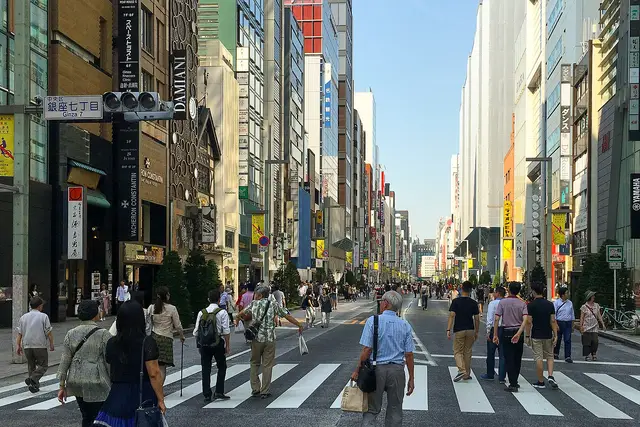
Ginza, Yurakucho and Hibiya guide
From Ginza's main street of department stores and old shops to theater-filled Hibiya and the bars under the tracks at Yurakucho and Shimbashi. It is all walkable: shop by day, drink under the railway at night.
Things to see 4 classics
"Classics", "For visitors" and "Local picks" are this site's editorial picks, not a measured popularity ranking.
- 2
Tokyo International Forum
Known for its ship-shaped glass hall. The plaza hosts the Oedo Antique Market on some Sundays.
- Museums
- Shopping & strolling
about 30 minFreeFine on a rainy day
Walk · About 8 min from Ginza ・ Just north of Yurakucho Station ・ 600m
- 3
Yurakucho under-the-tracks bars
Yakitori stalls and izakaya packed under the JR viaduct. Drink from early evening as trains rumble overhead.
- Food & markets
- Night views
about 60 minFreeFine on a rainy day
Walk · About 7 min from Ginza ・ By the Hibiya exit of Yurakucho Station ・ 400m
- 4
Tokyo Midtown Hibiya and the Godzilla statue
A mall whose 6th-floor garden overlooks Hibiya Park. A Godzilla statue stands in front of Chanter next door.
- Shopping & strolling
- Views
- Anime & film
about 60 minFreeFine on a rainy day
Walk · About 7 min from Ginza ・ Connected to Hibiya Station ・ 600m
Show on map
ClassicsFor visitorsLocal picks
Suggested routes
Times assume a 9:00 start. Travel times are estimated from distance and vary with waiting and crowds.
Ginza's main street to Hibiya, then the Yurakucho arches at night
Leave 9:00 → until about 15:33 (about 6.5 hr)
- 9:00Ginza
about 10 min by transport
9:10Ginzastay about 2 hrabout 3 min on foot
11:13Matsuya Ginza (food hall)stay about 45 minabout 2 min on foot
12:00Ginza Itoya (stationery)stay about 45 minabout 8 min on foot
12:53Tokyu Plaza Ginza (Kiriko Terrace)stay about 30 minabout 6 min on foot
13:29Tokyo Midtown Hibiya and the Godzilla statuestay about 60 minabout 4 min on foot
14:33Yurakucho under-the-tracks barsstay about 60 min
On weekend afternoons Ginza's Chuo-dori becomes a car-free street. Everything here is within walking distance.
Plan this routeShimbashi and Shiodome: railway history and the salaryman's town
Leave 9:00 → until about 11:59 (about 3 hr)
- 9:00Ginza
about 11 min on foot
9:11Old Shimbashi Station Railway History Exhibition Roomstay about 30 minabout 4 min on foot
9:45Nittele Big Clock (Shiodome)stay about 15 minabout 4 min on foot
10:04Shimbashi SL Square and New Shimbashi Buildingstay about 30 minabout 2 min on foot
10:36Karasumori Shrinestay about 15 minabout 8 min on foot
10:59Hibiya OKUROJIstay about 60 min
The Nittele clock only performs at set times. Shimbashi's bars start filling up in the early evening.
Plan this route
Main ways to get around
Ginza, Marunouchi and Hibiya subway lines (Ginza Station)
Three subway lines meet underground at Ginza Station. It has many exits, so check the number of the exit nearest your destination first.
JR Yamanote and Keihin-Tohoku lines (Yurakucho, Shimbashi)
Yurakucho is one stop from Tokyo Station and Shimbashi is two. Either is a 5–10 minute walk from central Ginza.
Toei Asakusa subway line (Higashi-ginza, Shimbashi)
Runs through onto the Keikyu and Keisei lines, so some trains come straight from Haneda or Narita airport without a change.
Getting to Ginza
“Classics”, “For visitors” and “Local picks” are our editors' picks, not a measured popularity ranking. Travel times are estimates. Please check prices, opening hours and operating days with the official sources before you go.
Local food specialties
Foods introduced as local specialties of Ginza, Yurakucho and Hibiya. They are listed by dish, not by shop, and are not recommendations.
Rice dishes
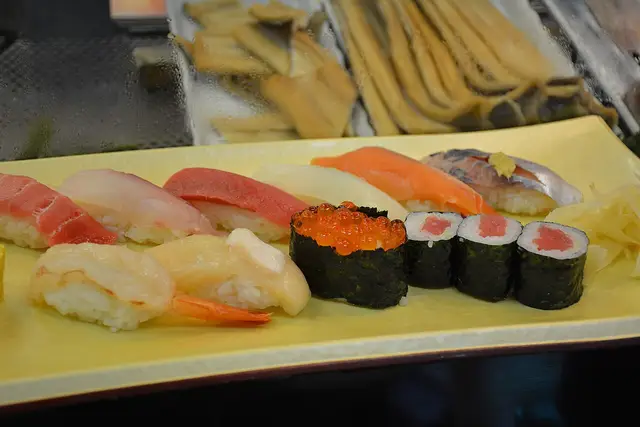
Edomae sushi
江戸前寿司
Nigiri sushi that spread through street stalls in the Edo period; a signature Tokyo food.
- Known in
- All over Tokyo
Hot pots & soups
Chanko-nabe (sumo wrestlers' hot pot)
ちゃんこ鍋
Hot pot with meat, fish and vegetables, eaten by sumo wrestlers. Many shops run by former wrestlers in Tokyo.
- Known in
- All over Tokyo
Seafood
Unagi kabayaki (Kanto-style grilled eel)
鰻の蒲焼(関東風)
Eel split along the back, steamed, then grilled with sauce in the Kanto style.
- Known in
- All over Tokyo
Noodles
Tokyo-style soba
江戸のそば
Soba that spread in the mid-Edo period; a representative Tokyo dish, with many soba shops.
- Known in
- All over Tokyo
“Find places serving it” opens a map app search for the dish name and the place name. The results are not chosen or recommended by this site. Please check with the shop whether it serves the dish.
Traditional home dishes of Tokyo (30)When to go
March–May and October–November are best for walking. July–August is hot and humid (26–27°C on average); September–October is the wettest. Winter is dry and sunny.
Point at a month to see its temperature and precipitation.
Temperature (line: average; band: low to high)
Precipitation (mm)
Typical seasons
Cherry blossoms (Ueno, Chidorigafuchi)
Sanja Festival (Asakusa)
Sumida River Fireworks
Autumn leaves (ginkgo avenues)
Show as a table
| Jan | Feb | Mar | Apr | May | Jun | Jul | Aug | Sep | Oct | Nov | Dec | |
|---|---|---|---|---|---|---|---|---|---|---|---|---|
| High (℃) | 9.8 | 10.9 | 14.2 | 19.4 | 23.6 | 26.1 | 29.9 | 31.3 | 27.5 | 22 | 16.7 | 12 |
| Avg (℃) | 5.4 | 6.1 | 9.4 | 14.3 | 18.8 | 21.9 | 25.7 | 26.9 | 23.3 | 18 | 12.5 | 7.7 |
| Low (℃) | 1.2 | 2.1 | 5 | 9.8 | 14.6 | 18.5 | 22.4 | 23.5 | 20.3 | 14.8 | 8.8 | 3.8 |
| Rain (mm) | 59.7 | 56.5 | 116 | 133.7 | 139.7 | 167.8 | 156.2 | 154.7 | 224.9 | 234.8 | 96.3 | 57.9 |
Temperature and precipitation are Japan Meteorological Agency normals (1991–2020, Tokyo). Seasons are typical timings and can shift by a week or two each year. JMA data
Sightseeing taxis and private charters (driver-guided)
Hire a taxi by the hour and visit the places you choose. Some companies have drivers who guide you at each stop, and some can provide drivers who speak other languages.
Nihon Kotsu
Tokyo sightseeing taxis with drivers who hold qualifications such as the Tokyo City Guide certificate and guide you along the way. Advance booking and hourly charter; guiding in foreign languages is also available.
Languages: English, Chinese
Example fare: 3.5-hour course from ¥23,900 incl. tax (fare from ¥19,400 + EDS charge ¥4,500) (official site, checked Nov 20, 2026)
Hinomaru Kotsu
"DAYTRIP TAXI": long-distance sightseeing taxis for day trips from Tokyo to Nikko, Mt. Fuji, Hakone, Kamakura and more. Fixed fares, guided by in-house certified drivers, with English available.
Languages: English
Example fare: Kamakura one-day course from ¥53,300 (official site, checked Nov 20, 2026)
Fares and services can change. Book and check current fares on each company’s official site. This site has no partnership with these companies and receives no referral fees.
Practical booking & planning links (Ad)
- Activities, tickets & local tours
- Popular observatories, museums and theme parks increasingly require timed-entry tickets booked in advance. For countryside spots with infrequent buses, a local day tour can save hours.
- KlookKKday
- Rental cars
- A rental car is practical when travelling straight from an airport or exploring rural areas with few trains. Request child seats, an ETC toll card, or winter snow tyres when booking.
- Klook
- Restaurant reservations & food tours
- Well-known dinner spots and course restaurants often fill up days ahead—reserving a table saves waiting in line. Guided local food tours are also a great way to try regional dishes.
- Klook
We list only well-established booking services. This site may receive a commission if you book through these links (each opens in a new tab).
Comment on whether your booking was helpful
Sources
Local food specialties
Each specialty was checked against an official page (prefecture, municipality, tourism association or JNTO) on 2026-11-17. The descriptions were written by this site.
- Edomae sushi: www.gotokyo.org
- Chanko-nabe (sumo wrestlers' hot pot): www.gotokyo.org
- Unagi kabayaki (Kanto-style grilled eel): www.gotokyo.org
- Tokyo-style soba: www.gotokyo.org
Photo and data credits
Pedestrians on Chuo-dori, the main street of Ginza Daniel Ramirez (CC BY 2.0) / A plate of nigiri sushi with tuna, salmon, shrimp and salmon roe Cheng-en Cheng (CC BY-SA 2.0). Cropped and resized.